Stratigraphy
Most of the time, archaeologists need to look underground to find traces of what people did in the past. The soil holds the story of humans like us throughout history, functioning as a great book written over time that tells the actions, tastes, and lives of both children and adults from past ages. Archaeologists work to uncover the secrets that the ground holds, step by step.
Imagine you have a stack of colourful blankets, one on top of the other. Each blanket represents a different time period, and just like our pile of blankets, the Earth is made up of many layers! Stratigraphy is the study of these layers in the ground. Each blanket varies in size, shape, texture, and pattern. When archaeologists dig into the Earth, they act like detectives uncovering secrets from the past. Each layer of dirt, rock, or sand (and the ancient objects it might contain!) gives us information about the time it was formed and the events that happened. As we archaeologists proceed in our "investigation," we follow a simple idea: the lowest layers are usually the oldest, while the newer layers sit on top. But this isn't always true! For example, if you were to dig a deep hole to hide treasure and then cover it back up, that treasure layer would be deep down but also the newest part of the story. You can see that, just like detectives, details are super important for archaeologists!
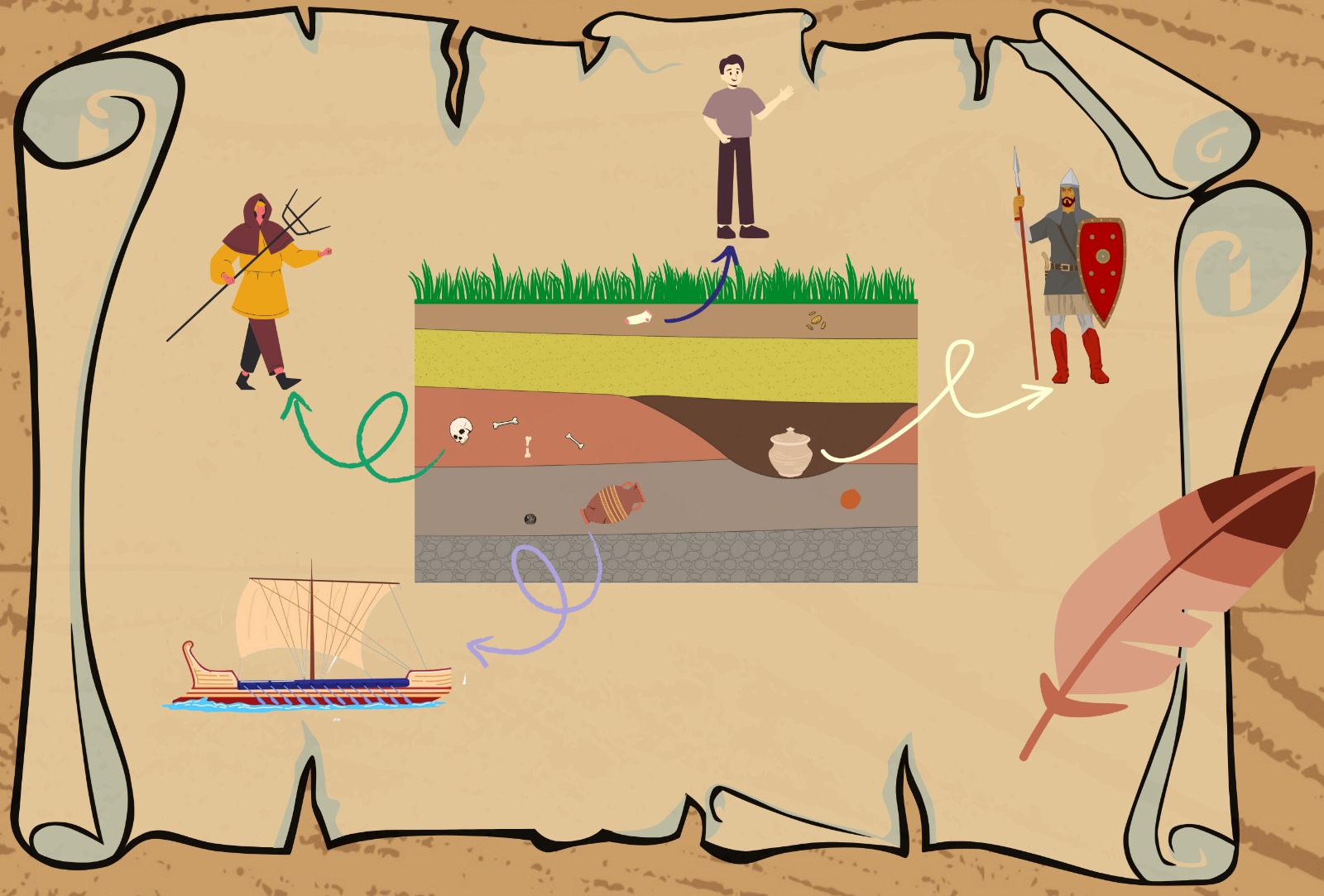
The name stratigraphy comes from stratum, the word for layer in Latin, the language of the Ancient Romans. Every layer represents an action and tells us how it formed, both natural and manmade. For instance, the bottom layer may contain prehistoric tools from when people first learned to create objects. The next layer might reveal a Medieval village with homes and churches, while an upper layer could have modern coins or farming tools. By examining these layers, archaeologists can learn about how people lived, what they ate, and even what the climate was like.
Just as you can think of a story by looking at each blanket in your stack, scientists also tell the story of our planet by studying its layers and the actions that created them. Isn't that cool?