Archaeological story
After you read all the previous methods, you probably understand that they have different uses, pros and cons. This means that archaeologists most of the time combine all of these methods depending on what they find.
Archaeology is all about creating a story based on what is found. And now it is your turn to create such a story through time! Below you can find an image of different layers in the ground (Stratigraphy!), together with a few things in those layers. By remembering the different techniques you previously saw, you can now create your own story of what happened at this place.
Try to answer the following questions in your story:
- What happened before, what happened after?
- Who were the people who lived in this placed, using what is found?
- What of the previous methods (Stratigraphy, Bioarchaeology, Radiocarbon dating, Dendrochronology) can be used for what?
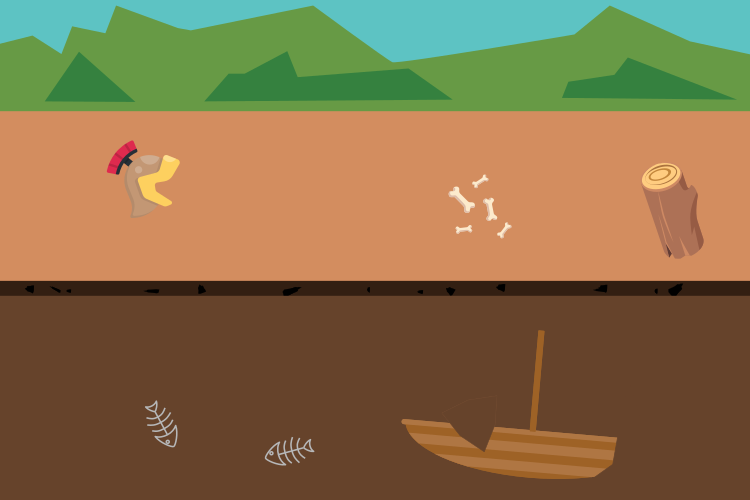

This looks like the remaining part of a boat. Maybe this tells us something about the people that used it?

Fish skeletons. Perhaps it is something these people ate, but can we know what kind of fish this was?
Pieces of charcoal are present in the dark middle layer. Most of the time this is a sign that there was a big fire.

A large piece of wood. Perhaps from a house or building.

Very small pieces of bone. It almost looks like chicken bones, but how can we know this for sure?

A helmet, Roman by the looks of it.
Have you got your own story in mind? Below we wrote our own story, so let's compare it with yours!
Story
Let's start by finding out what happened the earliest. For this we can use stratigraphy! As you probably already know by now, the oldest is always the bottom layer, while the youngest is always on top. With this information we know that the layer with the boat is the oldest. After that, something happened which left a layer of charcoal. And finally there is a layer with a helmet and bones.
In the oldest layer we can find a boat and some fish bones. Because of that, we think that the people who lived here were probably fishermen. If we use bioarchaeology, we can also figure out what fish the bones are from and what they were catching and eating! We also don't know how many years ago these people were living there, but luckily for us there is a wooden boat. If we use carbondating and dendrochronology, we can probably figure out when these fishermen were living in this area!
Above the fishermen, we have a small layer with charcoal. When archaeologists find such a layer, it often means that something was burned. It could be that someone set fire to the village of the fishermen, or that there was a natural forest fire. Unfortunately we can't really know what caused it. But since charcoal is created from burning plants, we can also use carbondating to know when this fire happened!
In the top layer, we found a helmet, some bones and a piece of wood. Since the helmet is clearly Roman, it was probably the Romans who came here after the fire. Perhaps we can confirm this with the other things we found?
As you probably know by now, the piece of wood can be used for carbondating, together with dendrochronology, to find out when the Romans were there. Since the piece of wood is also quite big, it was perhaps used in a small Roman house. Thanks to zooarchaeology, we can also know for certain that the bones we found are from chickens. And chickens are something the Romans brought to Western-Europe!
With everything we found, we can try to puzzle our story together. First there was a village of fishermen, but some time later the village was probably burned down. Perhaps this was done by humans, or perhaps it was a forest fire during a very hot summer. Either way the Romans came to this place after, and also built a village here and brought some chickens with them.
By using the methods discussed on this website, archaeologists can better puzzle together such stories! Without them it would be a lot more difficult to know what happened.